
Why? How does the ARRI Orbiter fit into your working dynamic?
In photography, we always manipulate the attributes of light in terms of its shape, texture, intensity, and color. We are equally interested in the nature of light sources and how they change when they bounce off objects and surfaces or pass through different materials. These attributes make up the aesthetics of light, which is vital for cinematographers. It is one of the pillars that give uniqueness to a story, alongside composition, camera work, and color grading. Working with light affects the storytelling, aesthetics, and how we perceive what we see on screen. It can have a significant emotional impact on the viewer, much like music.
We have a variety of light sources designed for different purposes (Fresnel, PAR, LED panel, tubes, etc.) and also filters, diffusers, reflective elements, and much more. However, the design of the ARRI Orbiter and its accessory integration system allows us to combine these attributes over a much broader range in a single light source. With the Orbiter, we can achieve sharp shadows, even at close distances, as well as soft and ambient lighting, with a wide range of intermediate instances. Its light beam can be shaped with different optics, transforming it into various types of existing fixtures like Fresnels or Open Face optics. It offers control over intensity, color, saturation, and the ability to program changes in all these variables. With ARRI Orbiter, I rediscovered playing with light. It offers great versatility in shaping light creatively.
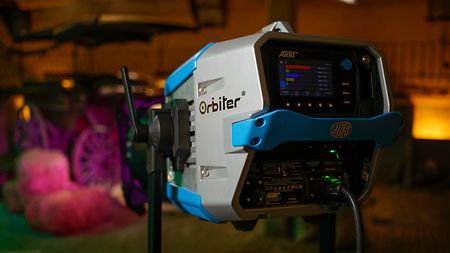
The ARRI Orbiter on set of Disney+ series “Los MacAnimals”