
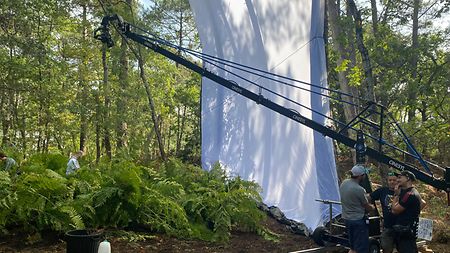
The ALEXA Mini LF in action shooting a forest scene
“The Animal Kingdom” belongs to a highly referenced genre: Science Fiction. How did you integrate this into your approach, and how did you distance yourself from it?
I don’t believe that “The Animal Kingdom” belongs to a particular genre, but rather that it’s a film that borrows from genres. It was my idea to make a hybrid film, like “Love at First Fight,” on the edge of what we mistakenly call genre. “The Animal Kingdom” is first and foremost an auteur film. During the preparation, we had a room at the production company, Nord-Ouest Films, where all people involved in the project came together: creature designers, storyboarders, set designers, costume designers. As we talked, we posted reference images on the walls. This covered a vast field, from Miyazaki to Bong Joon-Hon’s “The Host,” via Sidney Lumet’s “Running on Empty.” We also talked about Alice Rohrwacher’s films or Luca Guadagnino’s “Call me by your name.” In these films, you can feel the heat of summer on your skin, and nature with its dense, bluish greens. Each of them spoke to us in relation to the different sequences of “The Animal Kingdom.” They helped us define the intentions for each scene, and more generally, the trajectory of the film. In particular, we discussed the idea of boundaries between animals and humans, which runs through the whole story and is embodied by the creatures.

Still of the birdman in “The Animal Kingdom,” played by Tom Mercier
Why did you choose to shoot “The Animal Kingdom” in 2:39 with ALEXA Mini LF?
I really like the ALEXA, its dynamics and ergonomics. I’ve been shooting mainly with this camera for years. But this was the first time I used ALEXA Mini LF on a feature, even though I’d already worked with it on short formats. The idea of shooting in 2:39 came quite naturally. When we saw the first storyboards drawn in this format, we felt that it would work well for this film. In prep, I experimented with anamorphic lenses, but they took us too far towards a fictional, Spielbergian side of things, with its characteristic halo, bokeh, and flare. We were looking for softness, realism, something a little more down-to-earth. So, we decided to shoot in 2:39, but with ALEXA Mini LF and Primo 70 spherical lenses, which work well together. The Mini LF’s large sensor was also useful for lifting the characters out of the background in certain scenes.
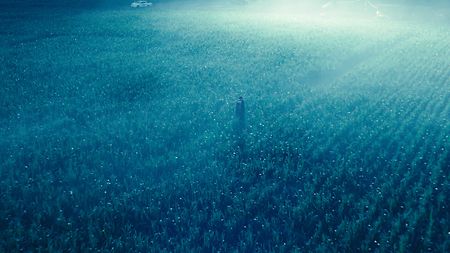
DP David Cailley chose ALEXA Mini LF partly because he wanted to have substance in the blacks
On “The Animal Kingdom,” you made some marked rendering choices, with a highly textured image. How did you work with the ALEXA Mini LF to achieve this result?
I used the ALEXA Mini LF at ISO 1600 throughout the film, even in daylight, with the idea of shifting the curve and obtaining more dynamic range in the highlights. I also wanted to use the large sensor to push sensitivity and get more substance in the blacks. This helped us with night and twilight scenes, of course. Basically, I really like the ALEXA’s grain, which is quite natural. The idea was to draw the digital image from the 35 mm techniscope, two perforations, which I like a lot, and obtain a grainy image with a contrast curve close to film. In our tests, this blended quite well with the grain we added in post-production, which enabled us to give the same texture to all the images. Throughout the shoot, we filmed each set in 35 mm. This served as a reference for calibrating the digital image. On “The Animal Kingdom,” the question of how to render the creatures’ skins with prostheses was central. From the outset, I felt that a textured image would bring softness and credibility to these effects, whether they were real, i.e. produced on set, or designed digitally.

To illuminate “The Animal Kingdom,” the filmmakers relied on ARRI M-Series lights, ARRIMAX spotlights, and SkyPanels
Color grading was a very important step. Did you use LUTs on set?
On “The Animal Kingdom,” I worked with colorist Yov Moor, whose work I found very convincing on several films. I’m thinking in particular of Audrey Diwan’s “Happening,” Valeria Bruni Tedeschi’s “Forever Young,” or Jessica Palud’s “Revenir.” These films had a texture that came close to 16 mm, even though they were shot digitally. In preparation, we did comparative tests in 35 mm, shot with the ARRI 435, and in digital, notably with make-up and prostheses on the skins. Based on these images, Yov was able to produce shooting LUTs. The calibration tests really convinced me that we were heading in the right direction. On set, I had three main LUTs—one for daytime, one for nighttime, and one for dawn—each of which had several stops. It was as if I were shooting in 35 mm, with two emulsions. This also enabled Thomas and his chief editor Lilian Corbeille to work with images close to the final rendering.
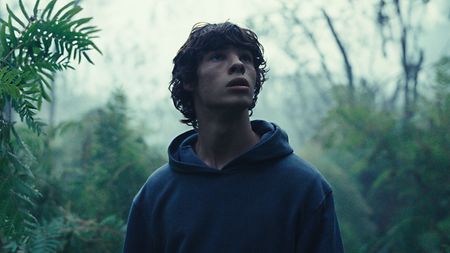
DP David Cailley had three main LUTs on set: one for daytime, one for nighttime, and one for dawn
There are a lot of dark outdoor scenes in “The Animal Kingdom,” notably the chase through a cornfield and the final scene in the forest. How did you deal with these in terms of lighting?
These scenes needed fairly heavy installations. We drew up several lighting plans with our gaffer Antoine Roux. We had considered using balloons, but it wasn’t practical in the forest with the trees. And for the chase, we had wide drone shots where the balloons would have been in the frame. Antoine and I quickly agreed on gondolas that would allow us to go much higher. In the end, we used four 18kW spotlights, two of them ARRIMAX, mounted 40 meters up on cranes. This allowed us to illuminate the scenes from both sides, almost 360 degrees. The setup was very pleasant to use because it meant we didn’t have to move in-between shots. In the forest, the setup was more or less the same, with three 18kW rigs, plus M90 fixtures to complete the lighting scheme. On the other sets, we had SkyPanels to work the sides or the face, and sometimes a small balloon on a stand. And, of course, we used M40 fixtures to create the incoming light on the windows. ARRI M-Series lights are part of the classic list that we always have with Antoine Roux.
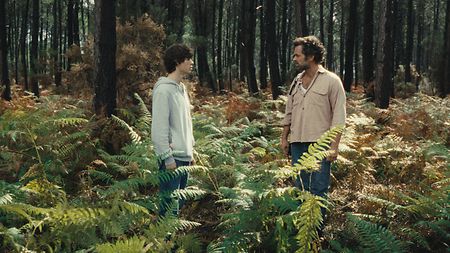
The DP wanted to create digital images close to 35 mm film