
Armani Exchange
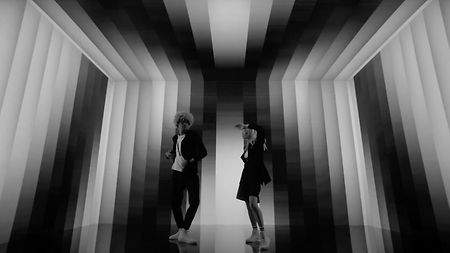
Black and white with a rich and dense gray range: Still taken from the Armani Exchange Spring Summer 2021 advertising campaign
What visual style were you looking for in this project?
I had worked for this brand before and knew that Armani Exchange has a well-defined aesthetic: elegant black and white with some touches of color and the use of a LED wall. In this case, I was in charge of the main campaign, the eyewear campaign, and the watch campaign. The brief proposed by the creative direction and director Michele Bizzi proposed abstract graphics on the LED wall—positioned on four sides and able to aid in lighting the subjects—with very dynamic images and wide-angle lenses in motion. We were looking for black and white with a rich and dense gray range. Motion graphics determined the lighting and produced reflections on glasses and watches so there was a colorimetry problem that required paying close attention to saturation and de-saturation. You had to get the white of the LEDs to match the white of the camera, and I had to work with Michele to have the graphics mapped in order to get interesting light and shadow patterns.
Why did you choose the ARRI ALEXA Mini?
Shooting with the ARRI ALEXA Mini means that you will be absolutely comfortable with the colors and latitudes. It's a camera that solves problems rather than creating them. It allows you to be sure you'll get the job done without surprises. In this case it was perfect for the richness of the shadows and the gentleness of the highlights. A second camera body hand-operated by Alex Crovi allowed even more coverage and availability of B-roll to enrich the editing. We also used ARRIRAW as our recording format.
Were there any particular difficulties while shooting?
We had to pay attention to the reflections on the glasses. We programmed ARRI SkyPanel front lights overhead so that they followed what was happening as closely as possible and increased the dynamics of the scenes. We mounted ring lights on the camera for aesthetics on close-up wide angles; the fall of the light helps to emphasize the movement of the camera. As soon as the subject gets closer or farther away, the image goes very quickly from underexposure to overexposure and you feel even more that it is moving.
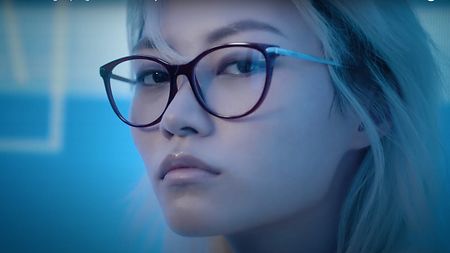
"We had to pay attention to the reflections on the glasses," says DP Brandstetter de Bellesini on the Armani Exchange eyewear campaign
How did you maintain camera stability?
I have been using the ARRI TRINITY with Luca Sportelli. I use it a lot because it offers flexibility, and that helps so much in fashion film photography. TRINITY allows you to better capture the dynamism of wide-angle close-ups and half-heights. This is always a problem with Steadicam because you have to be in hi-mode or low-mode. Particularly in fashion commercials, when you want to tell the story of outfits, you often find yourself with the camera between 90 centimeters and 6 feet, and that's exactly where Steadicams fall apart. Instead, with TRINITY, you can stand at that height, but also make very interesting changes in elevation seamlessly, without stopping anyone's work between takes. One can frame the logo tag on the pant at the height it is, and then continue shooting while moving comfortably. On projects of this kind, I now always ask for ARRI TRINITY.
To what extent did you use monitoring on set?
With DIT Claudio Palumbo, we were directly monitoring, de-saturating, and enriching the gray range and separating the different channels. Claudio would do color corrections in real time, then save them as LUTs to be passed to postproduction—a very convenient system that allows you to present the client and director with something very close to the final result right away. This was a fashion job, an environment where you are used to having a certain skin texture acquired with filters and retouching in postproduction, so you add or take away sharpness where you need it. It's mostly cosmetic corrections to look for the right density of grays while maintaining good contrast and giving the correct tone to different skin colors. It is a job closer to photo retouching than to traditional color correction.