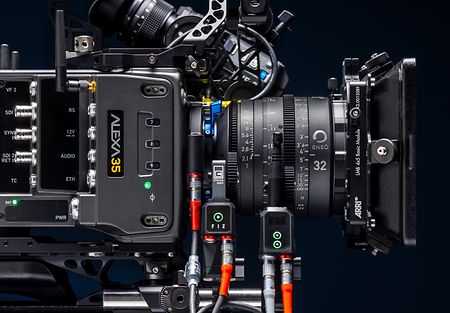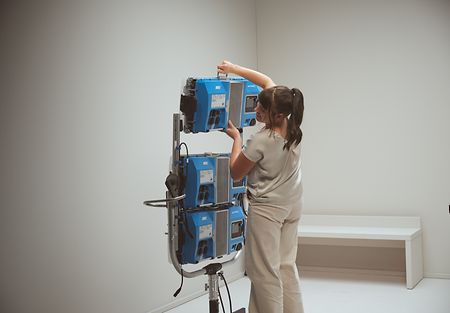
After admiring director Alauda Ruiz de Azúa’s work on “5 Lobitos” and “Querer,” Bet Rourich AEC teamed up with the filmmaker to shoot “Los Domingos,” which took home the top prize at the 73rd edition of the San Sebastián Film Festival. The film embraces an austere visual style and Nordic-inspired lighting, achieved through the ARRI ALEXA 35 camera and SkyPanel X soft light—key tools in crafting the film’s wintry, realistic atmosphere.
In this short interview, cinematographer Bet Rourich speaks with ARRI about her process, inspiration, and choice of equipment.
How did your collaboration with director Alauda Ruiz de Azúa come about, and what drew you to “Los Domingos”?
Like many others, I had seen “5 Lobitos” and “Querer” directed by Aluada and I thought both were wonderful. Alauda reached out to interview me, as she was looking for a DP for her next film. We met for coffee and talked about cinema, the project, and her way of working. A few months later, I was offered to shoot “Los Domingos.”
What visual and narrative references did you share?
We didn’t work with specific visual references. However, Alauda mentioned she wanted the film to convey a Nordic, heavy quality—a wintry look. So, I began studying Scandinavian impressionist painters such as Anna Ancher, Peder Severin Krøyer, the Skagen Painters, and Vilhelm Hammershøi. They weren’t direct visual references, but they helped me define the tone.
In terms of cinema, we revisited works by Bresson, Dreyer, and Ozu. The conciseness of their language and their categorical simplicity inspired us to pursue a similarly minimalistic approach for “Los Domingos”—both in camera language and in lighting. While we weren’t chasing specific references, revisiting those films helped us find the essence of what we wanted to capture and how we wanted to shoot it: with restraint and simplicity.
DP Bet Rourich finds inspiration in the austerity and simplicity of language for her work in both camera and light.
How did the convent location and the color palette influence your lighting and art direction choices?
We shot most of “Los Domingos” in Bilbao, and the convent location was in Gernika, about 30 minutes from the city. Alauda prepares the color palette with great precision before shooting, and all departments work in harmony with it. In the case of the convent, we filmed in a location that had been a cloistered convent until just a few months earlier—the essence of what the story was telling was still present there. Even in terms of art direction and lighting, it was the location itself that guided many of our artistic and narrative decisions.
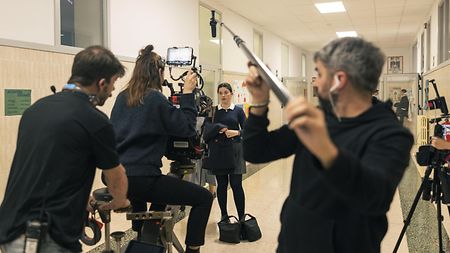
For the shooting of “Los Domingos,” Bet Rourich chose the ALEXA 35 and SkyPanel X.
How did you approach visual austerity?
By taking the concept of austerity to a strictly narrative level. Whenever it was possible to do something with less, that’s how we did it. For example, following the Nordic inspiration, I was very clear that whenever possible, I would use tungsten lighting in the apartments, even for daytime scenes.
But sometimes there were situations that clearly went against naturalism and the logic of the story. The Sunday lunches, for instance, took place in a large living room; in that case, switching on lights would have felt forced—the characters wouldn’t have realistically turn on lamps at midday with that big window. So, the location itself guided me in another direction: soft, diffused light that gently bathed the characters.
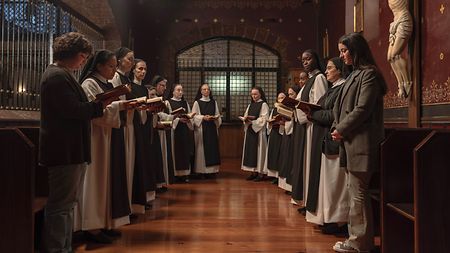
Another example is the convent. As I mentioned earlier, the real location itself inspired us. The cloistered nuns live and work with very little—so how could we translate that into lighting terms? I noticed the building had many fluorescent fixtures, and I decided to incorporate that into the visual approach for those scenes: soft but cold light—sterile, uncomfortable, functional, and inexpensive.
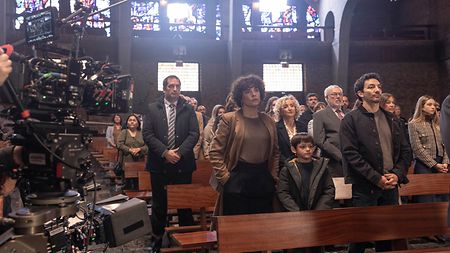
ALEXA 35 and SkyPanel X behind-the-scenes in “Los Domingos”.
The film mostly relies on a fixed camera. How did you decide when to keep the camera static and when to introduce movement, and what were you aiming to convey with camera movement?
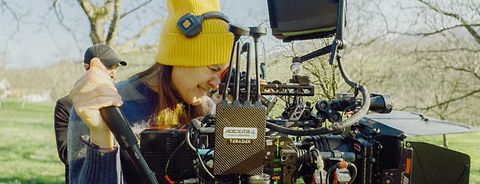
Our clearest inspiration for the mise-en-scène was probably Ozu. Alauda wanted to resolve everything with the minimum number of shots. The camera was functional, at the service of the characters—essentially invisible. That said, I do believe that sometimes the rules are meant to be broken. In this case, we were very clear that there were certain moments where a Steadicam could help us express what we wanted at that point. For example, we chose to work with a Steadicam to best capture the aunt’s point of view the first time she arrives at the convent. Other key moments where movement was crucial was with the final scene and the nightclub moment.
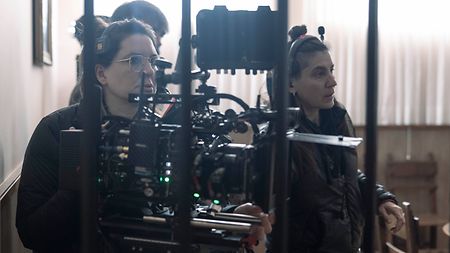
DP Bet Rourich, behind the camera, worked with an austere mise-en-scène, prioritizing a static camera and reserving movement only for key moments.
Why did you choose the ALEXA 35?
I had worked with the ARRI ALEXA 35 before, but “Los Domingos” was my first feature film using this camera. I wanted to experiment with a high ISO, and I knew that in the lower end of the curve at high ISO, the ALEXA 35 could give me exactly what I wanted in terms of color, noise, and skin tones. I carried out tests to decide and to create LUTs. I asked the colorist, Paula Ruiz, to experiment with the footage, and from those tests and some references I sent her, she created several LUTs. After testing them with the DIT, Adrián Hernandez, we settled on one in particular that worked beautifully throughout the entire film.
After visiting many churches, what did you discover about light and people’s behavior in those spaces, and how did that influence your blocking and lighting choices?
Our aesthetic approach to the ecclesiastical world—and specifically to church interiors—was documented not so much through cinematic iconography or art history, but through reality and everyday life. Alauda wanted to portray this world exactly as it is, and we wanted to stay true to that.
I don’t have much of a religious background since I was raised in a secular environment. So, I began exploring churches in person, observing how light behaved throughout different times of day. I also researched online how altars and church interiors—both modern and old—are typically illuminated, which types of lights are used, and what elements are highlighted. I wanted to gather as much information as possible to later apply it to the film’s visual narrative.
Within those possibilities, I also wanted to create a progression in the lighting of the church scenes. For example, the family church, where both a communion and later a funeral take place. I wanted to define a transition—a visual arc mirroring what the characters themselves experience—but it was crucial that this change remained grounded in realism.
“We wanted to show churches as they really are, with realistic light that accompanies the characters’ emotional arc,” says DP Bet Rourich. 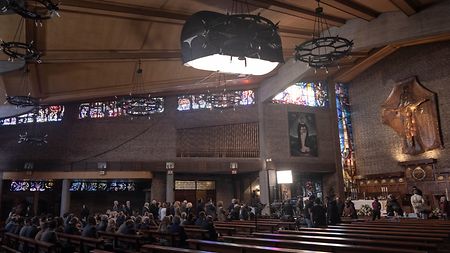
How did Scandinavian painting inspire you, and what role did the SkyPanel X play?
I mainly worked on lowering exterior light levels so I could use tungsten units indoors whenever the location required it. While this might seem easy in northern countries, technically it’s quite challenging in the Basque Country, where outdoor light changes constantly and you can go from sunshine to rain in minutes.
The SkyPanel X units were a huge help in dealing with the changing weather. Their robustness for exterior work and their ability to quickly adjust intensity as the outdoor light shifted were crucial. Our gaffer, Pep Zueras, was always anticipating what was needed and managed to secure a solid SkyPanel X package for our truck. Some scenes were over seven pages long, so we had to be ready to adjust the lighting on the fly, and the versatility of the SkyPanel X made that possible.
On the other hand, the combination of output and texture from the SkyPanel X—together with the ability to use the ARRI ALEXA 35 at high ISO—allowed me to shape the fixtures and the light textures in exactly the way I wanted. I can’t go on a shoot without at least one SkyPanel kit on the truck; it’s a piece of equipment that’s always part of the foundation of my lighting setup.